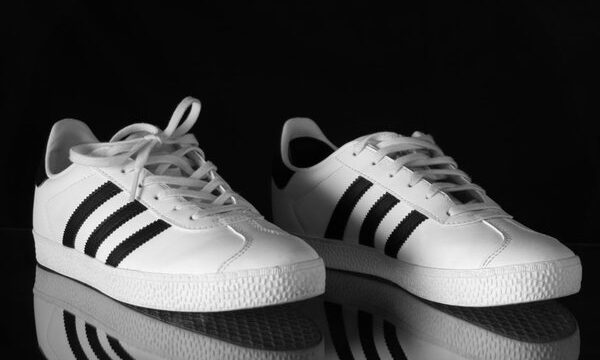

How should trainers fit? Close enough to feel secure, but roomy enough for your toes to spread as you walk. A good pair should not squeeze your forefoot, rub your heel or make you grip with your toes to keep the shoes on. The size printed on the box is only a starting point.
For most everyday trainers, aim for roughly 1 cm between your longest toe and the front of the shoe, with a comfortably snug heel and midfoot. That simple check can save you from buying a pair that looks right online but feels wrong after half an hour outside.
What a properly fitting trainer feels like
Stand upright in both trainers, wearing the socks you normally use. Your toes should lie naturally rather than curling or pressing into the upper. Your heel should feel supported without being pinched, and the laces should hold the middle of your foot without creating pressure across the top.
How much toe room should trainers have?
Around 1 cm of space beyond your longest toe is a useful everyday benchmark, recommended in NHS footwear guidance. It is a guide, not an exact measurement that guarantees comfort for every foot. Your longest toe might be your second toe rather than your big toe, so check the correct one.
For running trainers, some brands recommend about half to a full thumb’s width at the front because the foot spreads during impact. The amount depends on your activity, foot shape and the shoe’s construction. More space is not automatically better if your foot moves around excessively.
Check the shape as well as the length
Toe room in trainers means space above and beside the toes, not simply an empty gap at the front. If your little toe pushes against the side or the upper presses down on your nails, a longer size may still feel uncomfortable. A wider or differently shaped toe box could solve the problem more effectively.
Should trainers be tight around the heel?
The heel needs a secure hold, not a vice-like grip. A well-shaped heel cup sits close to the back of your foot and reduces unwanted movement. Slight movement can occur, particularly in softer casual trainers, but repeated lifting, rubbing or a feeling that the shoe might slip off suggests a poor fit.
If heel slip in trainers happens only when the laces are loose, try tightening them evenly or using the extra top eyelets for a heel-lock lacing pattern. If the heel still moves dramatically while the forefoot feels right, that model may simply be the wrong shape.
The midfoot should feel held, not squeezed
Across the arch and instep, a trainer should feel comfortably secure. The upper may touch your foot, but there should be no sharp pressure point, tingling or persistent ache. Adjustable laces help fine-tune this area, whereas a rigid slip-on design offers less flexibility.
Width matters here too. If the widest part of your foot spills over the edge of the sole or the sides bulge under tension, sizing up in length can create heel slip without fixing the width. Look for a wider fit or a roomier last instead.
A practical UK trainer sizing guide for buying online
UK sizes are useful labels, but they do not fit identically across brands or even across styles from the same brand. A UK 7 in a slim fashion trainer may feel different from a UK 7 in a cushioned running shoe. Avoid ordering solely from the size you have worn for years.
Measure both feet while standing, preferably later in the day when they may be slightly larger. Place each foot on paper, mark the back of the heel and the end of the longest toe, then measure the distance in centimetres. Use the larger foot when comparing your result with the specific brand’s size chart.
Remember that a foot-length measurement is not necessarily the same as the shoe’s internal length. Follow the retailer’s stated measuring instructions rather than automatically adding a centimetre to every chart. Our guide to measuring your feet at home can help you repeat the process consistently.
The five-minute fitting test
Walk, turn and test a gentle slope
Walk around the room, turn sharply and rise onto your toes. If possible, try a few steps down a safe incline or a single stair. Your toes should not repeatedly strike the front, and your heels should stay reasonably secure.
Compare both feet rather than trusting the first
Imagine ordering trainers for a daily commute: the right shoe feels perfect, but your slightly longer left foot touches the end when you step downstairs. That is a reason to reassess the size or shape before removing the tags, not something to ignore because one foot feels fine.
Test indoors on a clean surface so you can still follow the retailer’s returns policy. Do not assume painful pressure will disappear when the trainers are broken in.
When should you size up, size down or change width?
Consider a half size up when your longest toe touches the end, especially during walking or running, and the rest of the shoe is not excessively loose. If the fit is already generous around the heel, a different model may be better than increasing length.
Consider a smaller size if your foot slides forwards, the heel escapes repeatedly and there is clearly excessive room at the toe. First make sure the issue is not simply loose lacing.
Change width or toe-box shape when the sides of your forefoot feel crushed but the length is correct. A wider trainer can offer relief without introducing unnecessary extra length. For more options, explore our guide to trainers for wide feet.
Frequently asked questions
No. When standing and walking, your longest toe should have a little clear space ahead of it. Regular contact with the front suggests the trainer may be too short.
Not necessarily. Half to a full thumb’s width is commonly suggested for running shoes. For everyday use, roughly 1 cm is a practical starting point, provided the heel and midfoot remain secure.
Watch for sideways movement, wrinkling caused by excessive space, or a foot that slides despite sensible lacing. Check heel shape and length before assuming width is the only problem.
Some soft uppers may give slightly with use, but you should not count on a trainer becoming longer or a painful toe box stretching enough to fit. Choose comfort from the start.
Finding your best fit
The right trainers give your toes breathing space while keeping the heel and middle of your foot comfortably controlled. Check length, width, depth and movement together, not just the UK size label. A few careful minutes indoors are worth far more than hoping an uncomfortable pair will eventually feel right.